Drought, Hail, Heavy Rain, High Winds…and Wilt

Just when you thought your 2017 corn crop had suffered every indignity that weather and the grain markets could dish out, another hit to the area’s corn arrived in the form of Goss’s wilt. According to research data from Dupont Pioneer, yield robbing Goss’s wilt and leaf blight is a bacterial disease that causes leaf loss, poorer stalk quality, and light test weight corn. Higher levels of corn residue from corn-after-corn production and reduced tillage contribute to the spread of the disease and these are both practices we see in this part of SD. Summer storms that produce hail, wind, or rain that damage corn leaves can also impact the severity of the infection and loss in any growing season. This year, there are farmers in our region that have experienced all of these weather events. Crops have rebounded in some areas with summer rains but another culprit looms that can reduce yields even more.

Goss’s wilt overwinters in infected corn residue and host plants such as green foxtail, barnyard grass and shattercane. From this infected residue, bacteria are transferred to growing plants. Bacteria invade the plant tissue through the wounds caused by hail, heavy rain, wind, or mechanical damage. Infection can happen at any stage of development. Wet weather and high humidity encourage the spread of the disease. Sadly, Goss’s wilt isn’t too fussy and will spread in hot dry conditions as well. Even if you remained in a drought area this year, you still are susceptible to the Goss’s infection.
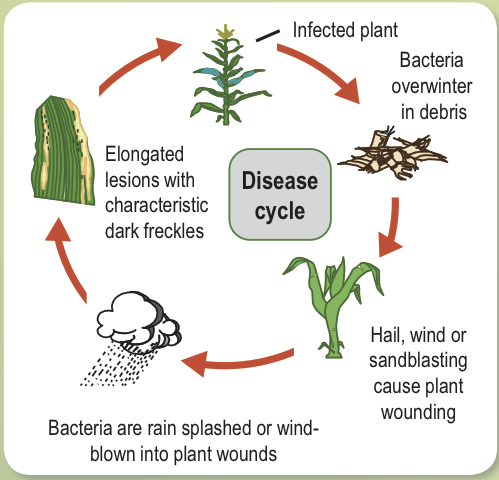
Disease cycle of Goss’s wilt in corn

Goss’s wilt is in our area and once it is here, it is here to stay. The disease, now a crop management factor for us, may be transmitted from field to field by tillage equipment, balers, and ever-present South Dakota wind. Management of the disease is critical.   However, Goss’s wilt is a bacterial infection – not fungus, so foliar fungicides are not effective and there are no rescue measures available to control the disease. Crop rotation, tillage when practical, reducing crop residue, and minimizing grassy weeds can help.

“Varnish” on leaves give them a frozen appearance and they may eventually wilt and dry up

The primary method for management of this disease is hybrid resistance. Levels of resistance are rated in Pioneer brand corn seed using 1 (susceptible) to 9 (resistant) scoring systems. This fall, when making your hybrid seed selections to plant in 2018, visit with your seed provider about the hybrids that offer the appropriate levels of resistance for each of your fields.

For some growers in this area, the dismal growing conditions of the spring improved throughout the summer months. Hail, wind, and drought played a role this year as well. Though it can be frustrating to deal with these issues, it is amazing how resilient the corn and soybean plants are. Yields look much more promising than we deemed possible earlier on in the growing season. Mother Nature can deal out some tough blows as we have seen in hurricane affected Texas and Florida and Montana’s wildfires. Guess I‘ll stick with the hassles we’ve got. Wilt and all.

Featured Image Credit: Purdue University

Time to Prove You’re a Pioneer Hybrid Yield Hero

Bauman Agency is pleased to introduce our Hybrid Yield Hero contest. The yield contest is for each individual Pioneer corn and soybean product from the 2017 growing season. Each hybrid winner will be displayed on a banner that will remain on the Bauman Agency “Wall of Fame” for the year. They will also win a personalized Bauman Agency jacket and an invitation for 2 to our Yield Hero Dinner.

CLICK HERE TO ENTER

Rules and Regulations

  1. All entries must be harvested from Pioneer brand seed purchased from Bauman Agency.
  2. Each entry must consist of no less than 10 contiguous acres.
  3. Only one entry per person per hybrid. Producers may enter as many hybrids as they purchased.
  4. Each entry must be submitted on a separate entry form.
  5. All yields will be adjusted to dry bushels per acre (13% moisture for soybeans, 14% moisture for corn.)
  6. Yield evidence must be presented as scale tickets or a contiguous yield map.
  7. Irrigated and dryland acres will be in separate hybrid divisions.
  8. Winners must agree to have their picture taken. Bauman Agency will use these photographs in print and social media advertising.
  9. Deadline for entries is December 1st, 2017.
  10. If a tie should occur, the winner will be decided by whomever submitted the most Yield Hero entries.

Complete ALL of the information in the attached form and submit the entry form along with all production evidence to:

Bauman Agency
19897 SD Hwy 37
Huron, SD 57350

Reminder: All entries are due at the Bauman Agency office by December 1st, 2017.

25 Years in the Business

Congratulations to Curt and Louise for 25 years of seed, crop insurance, and planter technology ….from your side of the fence. They are honored to serve South Dakota’s farming communities and look forward to another 25 years of service.

A New Member of the Bauman Agency Family

Please join us in congratulating Jon and Callee Wachter on the newest addition to the Bauman Agency family. Their youngest child, a beautiful daughter, was born on June 4th 2017. Evangeline Eddie Wachter joins a lively Wachter household, including Charleston (5) and Georgia (3). Welcome to the farm, baby Evangeline!

Improving and Advancing, It’s the American Way!

As I contemplated the theme for this month’s ramblings, we were in the throes of an impending “no-rain disaster.” Growers were not interested in walking their fields with me to analyze their planter’s 2017 operating performance. The importance of a perfect stand seems minimal when dust is blowing across the field. Now that some relief has been granted, we need to look forward to 2018. The best time to discover needed planter improvements is when corn plants are small enough to analyze. For example, at this stage it is easy determine the timing of emergence, one of the key factors in determining final yield potential.

One of the newest tools from Precision Planting is the “Pogo.” This Pogo is not to be confused with the pogo stick of my youth, which I never did master. The art of bouncing and balancing at the same time (on a gravel driveway) eluded me. The Precision Pogo is an instrument used to help evaluate corn stands and planter performance. This device allows us to measure emergence, singulation, spacing, final planted population versus intended population and more. All of this information is gathered and put on scorecard to help us make the correct adjustments and needed improvements to our planters before we break them out to plant in 2018. This is a great tool and I encourage you to contact our office so we can schedule a field of yours to Pogo. Now is the time to look forward to next year!

As I marvel at state- of- the- art- technologies in agriculture today, like the Pogo and other Precision Planting technology planter components, I am feeling proud, lucky, and a bit patriotic. US Secretary of Agriculture Perdue recently released this comment: “Floods, droughts, and natural disasters are a fact of life for farmers, ranchers, and foresters.  They have persevered in the past, and they will adapt in the future – with the assistance of the scientists and experts at USDA.  To be effective, our research and programs need to be focused on finding solutions and providing state-of-the-art technologies to improve management decisions on farm and on forest lands.”

The American farmer has been persevering, adapting, improving, and advancing with good ol’ Yankee ingenuity for more than 200 years. While the weather is a factor that farmers cannot control, we CAN control how we respond to them. Utilization of the continued improvements in available technologies is one way to combat the effects of Mother Nature. Pushing crop yield barriers is something all farmers strive to accomplish. We can’t stop now, it’s the American way!

Image Credit: Torbakhopper

Acreage Reporting Deadline: July 15th

It’s time to report your planted crop acres! Please pick up your maps from your Farm Service Agency and bring them and your planting information to us here at the Agency. We will assist you in completing your maps, and report your acres so you’ll need only drop your completed “as- planted” maps back at FSA. Acreage reporting is a critical step in determining your coverage and your premium.

We are happy to serve you in this process of providing an accurate report. This year the 15th falls on a Saturday so the official final deadline is July 17. Allow plenty of time to complete this process. No errors = no headaches! (We will be closed July 3 and 4 for the Independence Day Holiday.)

Image Credit: Ze’ev Barkan

Five Foundations of Financial Literacy: Money $heep

Carrie Wintle grew up on an area farm. Her promotion of financial literacy for youth of all ages is inspiring. I have asked her to guest author this month’s article of the Prairie Tracks for you to gain an understanding of the work she is doing. The ag community, and in fact every consumer, should be armed with these financial fundamentals, and learning them at a young age is all the better. An accomplished pianist, dancer, and recent college graduate with graduate school on the horizon; Carrie has now added children’s book author to her resume. I have ordered my copy of her children’s book, Mr. Money $heep, and, after I study up, I might let my kids and grandkids read it! I asked Carrie to tell us a little bit about herself and her book this month — enjoy!

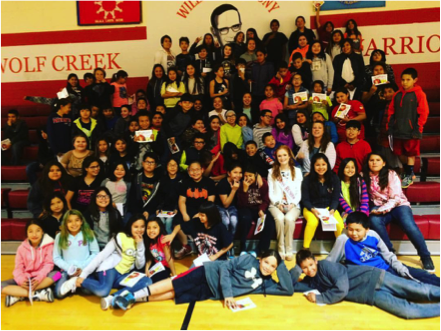
Carrie with some of her best students

The Origins of Mr. Money $heep

As a young girl, raised on a farm just South of Cavour, SD, I was heavily involved in 4-H. My love for animals was unbreakable and led me to try showing all of them in 4-H, even my cat (I wouldn’t recommend this). Eventually I stumbled upon the idea of showing a lamb. Soon after, I bought my first lamb, Pookie. Thus began a 10-year journey that grew from one lamb to a 40 plus sheep flock.

This experience, along with my interest and studies in math, led to my platform as a Miss South Dakota contestant, Money $heep. The goal of Money $heep is for youth to build a financial foundation from which they can tackle the financial world. Although I use my personal experience of owning lambs to talk about financial literacy, every student’s experience is different. The important part is for youth to learn how finances relate to their own personal life.

Money $heep is centered around the Five Foundations of Financial Literacy: budgeting, saving, income, loans/debt, and investment risk. These five financial topics equip youth with a base of financial knowledge they can use in their lives and the world. I choose to focus on this base of knowledge because it is critical for youth to learn the basics before advancing into more complex areas.

Think of it like mathematics. Students learn to add, multiply, divide, and subtract in elementary school before advancing into harder classes. If a student never learns the beginner topics in math, they will not be able to learn the harder topics. He or she will continue to progress through math classes without understanding the material. The same is true for finance. If youth neglect the basic financial concepts, by the time they reach adulthood they will be unable to truly understand harder topics.

Money $heep’s action plan involves an extensive speaking tour. As a contestant, I visit schools throughout South Dakota to speak about the Five Foundations of Financial Literacy. Every speaking engagement is different because all students have unique needs. I strive to make each presentation impactful by relating it to the audience and students. Furthermore, I authored an illustrated book called Mr. Money $heep with artist, Rayna Pearson. The book is written in an interactive, play format that allows the students to take part in the learning experience. The book can be purchased on Amazon, with all profits going towards purchasing books for students in South Dakota. Finally, thanks to a sponsorship from White Oaks Wealth Advisors, I donated 800 copies of Mr. Money $heep to the Rosebud and Pine Ridge Reservations in South Dakota.

Getting to travel the state to talk with students about Money $heep and the Five Foundations of Financial Literacy has been a blessing. Using my Finance and Accounting degree from the University of South Dakota to help youth build their own base of financial knowledge is exciting and rewarding. I am excited to see how Money $heep can help more students in the future.


Just One Thing at a Time, Every Time

Farmers today (and every day) hear about something he/she should be doing better, faster, and more efficiently. Every day brings another new technology to embrace, understand, and use. Every day there is news to digest, EPA warnings to heed, markets to watch, and opportunities to capture. Every day there is more to consider than there was than the day before. It seems that just when you upgrade to the latest/greatest whatever, someone comes out with a better idea. The speed at which information comes to us can be overwhelming and the volume of that information quite daunting. Perhaps the solution to riding the information train and avoid being left behind is this “Just One More Thing.”  How can I adopt just one more thing for certain aspects of my operation over time rather than implementing dozens of them spontaneously just trying to keep up?

Earlier this month, Bauman Agency hosted a day-long training for our customers focused on crop market outlooks, crop insurance and planter updates, technology, and crop management. We called it our Just One More Thing training with the goal of providing at least one good take-home piece of information from each segment of the day.

We were fortunate to host crop market expert Rich Morrison from Jacksonville, Illinois of Diversified Services. Rich presented his crop market outlook for 2017 and highlighted the tools to use to capture prices to meet goals and manage risk. Crop insurance was included in his list of tools as well as a new private product called Price Select. Price Select allows insureds to add months other than February and October to set their crop insurance price guarantees. The concepts that Rich talked about that day were, in my opinion, right on the mark. While he was speaking, I am pretty sure I was nodding my head to many of the suggestions he made. He cautioned us all to know our historical cost of production in order to know when we are approaching a good marketing opportunity. Guess I now have my One Thing from that session.

We also heard Bill Lankswerth’s counsel on ag financial risk management. Bill, from Louisville, KY, representing Agri-Financial Services, specializes in the development of positive financial relationships with lenders. His advice centered on how and what to compile and document to gain the support of our bankers.   The concepts that Bill talked about that day were, in my business partner’s opinion, right on the mark. (My business partner also happens to be my wife.)  While he was speaking my wife was nodding her head to each suggestion he made. Having a documented management approach for our farms was paramount to long term success. He insisted that a written overall strategic plan, including yield protection with crop insurance, product marketing and cost control was essential to gain bankers support and ensure long term profitability. My wife was all smiles! She likes to remind me that if a plan or goal isn’t written down, it doesn’t exist! I am a shoot-from-the-hip kind of guy and I find this process annoying, but, I had to admit that I now had my One Thing to take home from Bill’s session.

Decisions made about crop insurance coverage prior to March 15th are long term and remain in effect throughout the entire crop year. I truly believe that crop insurance coverage choices must be made with your goals for your operation and your risk management needs and crop marketing goals in mind, with an agent that understands and supports your goals. There is no one size fits all to crop insurance. Your risk management and marketing plan needs to be tailored to your needs. Visit with us about your farms coverage and get a quote for Price Select. This might be the One Thing that brings your best returns in 2017.

Image Credit: Will Scullin

Crop Insurance Deadline: March 15th

To be sure we provide the best coverage possible for you and your operation, we have scheduled an appointment time for your annual policy review. Watch your mailbox for your appointment letter and let us know right away if your scheduled time needs adjusting. We look forward to visiting with you soon. Thank you for insuring with us.

Image Credit: Dafne Cholet