Are You a Hybrid Yield Hero?

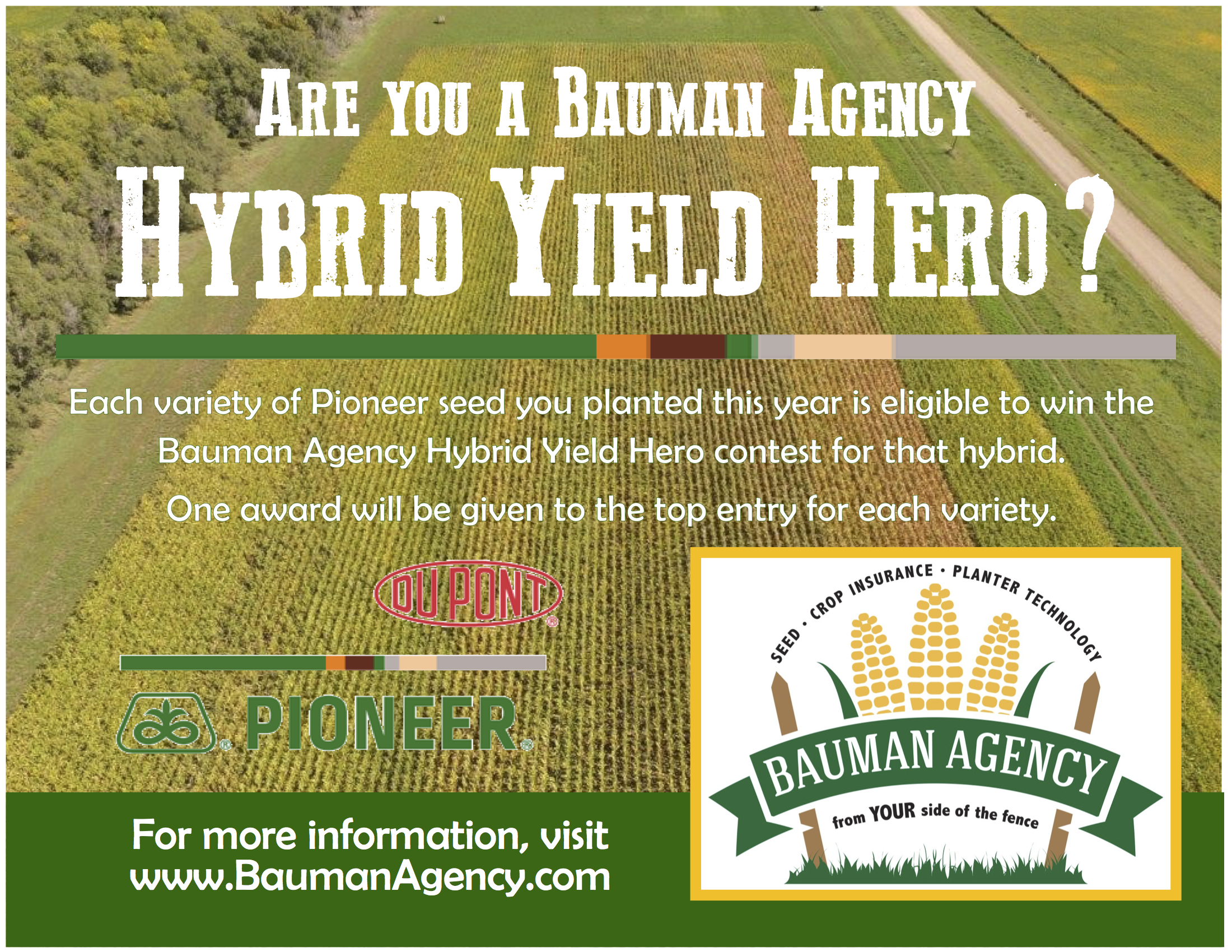
Bauman Agency is pleased to introduce our new Hybrid Yield Hero contest!
yield-hero-1

We are holding a yield contest for each individual Pioneer corn and soybean product for the 2016 growing season. The winner for each hybrid win a sign that will remain on the Bauman Agency Wall of Fame for the year. They will also win a personalized Bauman Agency jacket and an invitation for two to our Hybrid Hero award dinner!

How to Enter

  1. Download the Entry Form
  2. Fill out the form with information about you, your hybrid, and your operation
  3. Gather production evidence and supporting documentation
  4. Get the completed forms and the documentation to Bauman Agency at 19897 SD Hwy 37, Huron, SD by 4:30pm on November 15th
  5. Wait to find out if you are a Bauman Agency Hybrid Yield Hero!
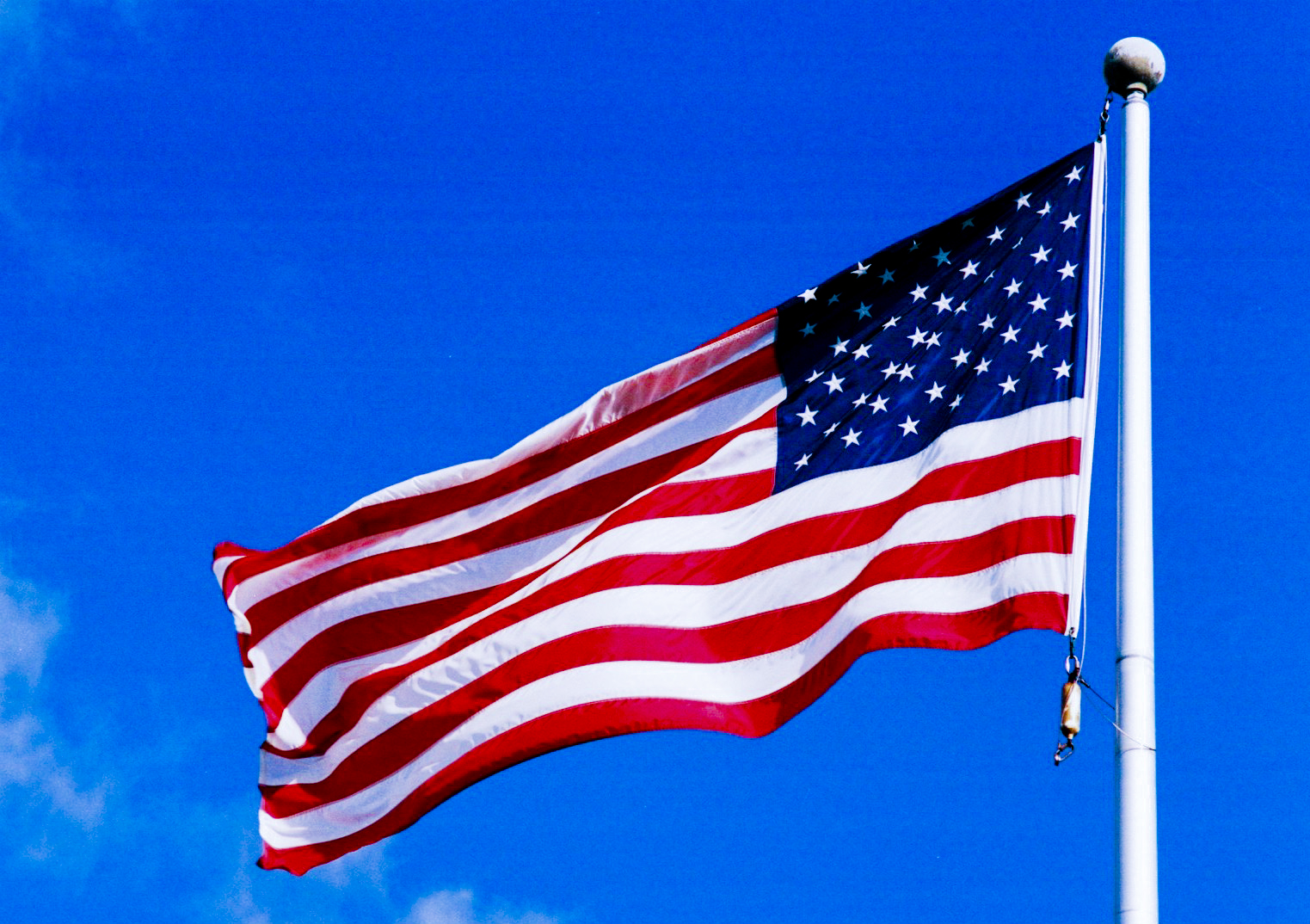
America Salutes the Farmer

Politics. By now, with a little over a month before the Election Day, we may be tiring of all the political banter surrounding us. We may like one candidate and object to the other, or dislike all of the options. Some may even prefer to bury their heads in the sand and hope it all goes away. With a concern over the election of just who will become the new commander-in-chief, it is more important than ever that our congressional delegations from rural states have backgrounds that support agriculture.

Agriculture and crop insurance are very politically charged issues.   Look how long it took to get the 2014 Farm Bill into action and the attacks waged on crop insurance from different fronts on Capitol Hill. Discussions on the 2018 Farm Bill will begin sooner than we think. Nearly every ag publication we read tells us that, as a whole, the American public doesn’t understand agriculture and that farmers and ranchers need to be better at telling our story.

Although they may not fully understand it, a survey, commissioned by National Crop Insurance Services and conducted by North Star Opinion Research, reveals a positive public perception of agriculture and crop insurance in America. This particular survey was conducted in April of 2016 with 1,000 registered voters interviewed by telephone with live interviewers. Quotas were set for state, gender, race, and age to reflect past voter turnout with a margin of error of +/- 3.1%.

When asked if funding for programs that help farms and farmers is important, more than half feel that it is very important and another third think that it is somewhat important. Only 7% of those surveyed replied that it was not too important or not important at all. This positive response reflects bipartisan support as the consistent results come across the board from Republicans, Independents and Democrats. The survey’s findings also show strong favorable and bipartisan views of farmers as a group (86%).

3133178187_e87f6f53fe_o

Discounted crop insurance is supported by a 79% to 17 % margin. Presented with arguments for and against federal crop assistance for farmers, voters still say it is appropriate to help farmers by a two to one margin. 81% of voters agree that a strong farming industry is critical to national security. They also think farmers and taxpayers are better served by insurance delivered by the private sector, rather than the federal government, by a more than 20 point margin (54 to 33%). More than two-thirds of voters agree that farmer’s should share in the cost of the programs that protect them, and that farmers pay too much or the right amount for crop insurance. Similarly voter’s think the amount of loss sustained before payments are made is about right.

These overall positive results were honestly somewhat of a shock to me. On any given day, I don’t have to look very hard to see media that paints the agriculture industry in a negative light. There are numerous blogs, columns, Facebook pages, special interest groups, etc., whose main goal is to discredit the agriculture industry, the safety of our products, and the wellbeing of our livestock. This poll is reassuring to me in that the average American still has a high level of approval for farmers and the programs available to us that help ensure a safe, quality food supply. As the election nears and Farm Bill discussions begin, it is important to remind our congressional leaders of these findings. Voters believe that crop insurance and agriculture programs have a positive impact on America. This gives us something to build upon in this election year and the time leading up to the creation of a new farm bill, whenever it is enacted. The public’s bipartisan support is there and it is up to us to make that support be heard!

Image Credit: Julian Carvajal

If That Don’t Beat All

I used to think that the more years I farmed, the more experienced I became. With that experience, the less shocked I would be at certain scenarios as I should have “seen them all.” Then reality happens and I am reminded that I still have a great deal to learn when trying to discern our volatile markets. Let me shed a little light on how today’s market fiasco affects crop insurance coverage for 2016.

First of all, I have seen more variation in corn crop conditions this season, within just a few miles – sometimes in the same section, than I can remember in any previous year.  I have walked fields that could easily yield over 150 bpa (bushels per acre), while a field across the road will have a hard time achieving 75 bpa. It seems that in one field it paid to till, and a mile down the road it had a negative impact. Typically, our corn yields are significantly higher than soybeans compared to national averages, but this year, with some timely August rains, soybean yields could be well above the historical corn/soybean yield ratio.

9621025941_a0fe777317_o

This Spring, both corn and soybeans were under price pressure as we set our crop insurance base prices with both crops well below the 2015 price guarantees. Corn experienced a short lived summer rally in late June that left prices well above our spring price, then rapidly retreated to levels that make producers cringe and buyers smile. Soybeans, on the other hand, initiated a rally that, even after softening, is still well above 2015’s levels.

Most market forecasts told producers that it would essentially be impossible to make money raising soybeans this season and for farmers to be sure to use any tools available to minimize their losses. Soybeans could well turn out to be the one crop that turns a profit in 2016 – if we accomplish the current yield estimation and still have our current prices.

Corn producers who had a 120 bu APH (actual production history) and selected a 75% Revenue Protection coverage level for crop insurance coverage were guaranteed 90 bpa or roughly $347 per acre of revenue coverage on their farm. If the current trend in corn prices holds through harvest (about 15% lower than the crop insurance spring projected price), that dollar coverage divided by a lower harvest price makes his new yield coverage 104bpa (about 15% higher than the projected price).

Soybeans on the other hand have experienced a price rally and so revenue coverage will go up to reflect the higher value of harvested soybeans. A producer who has a 36 bu APH with 75% coverage had about $240 /acre coverage. If the current price holds through harvest, his coverage will go up to $273 per acre. Given the outlook for soybean harvest in Beadle County we should be marketing up to our guaranteed bushels at the higher current levels. If market history rings true and my predictions follow the past years’ outcomes, every producer should do the opposite of what I say as the price may skyrocket to $12/bu!

One last thought, if ever we need to have a yield monitor, it is a season like this when we can discover the true winning hybrids and best management practices to use on our farms. Contact us about YIELDSENSE, a yield monitoring system that is available for your combine that will help make the best possible decisions for 2017. Let us help you use the tools you already have to identify what things worked and what didn’t. It is one of the few factors that is truly in our control.

Image Credit: United Soybean Board

Why Monitor What You Can’t Fix?

I am getting my shoulder fixed today. By the time this article is published in the Prairie Tracks I’ll be two weeks into my recovery and physical therapy, and on my way to a pain free and useful rotator cuff.  (I am really hoping that my time in the combine this fall will be with two useful shoulders).  Of course, it has taken a while to get to this point.  I moved from ibuprofen, to Aleve, to cortisone shots, to, “Well, we have monitored this downward progress long enough.  It’s time to fix it.”  I can’t say I am looking forward to going “under the knife,” but I am pretty thankful my shoulder can be fixed.

A tv ad I’ve seen recently poses the question, “Why monitor what you can’t fix?”   Isn’t that the truth?   Discovering there are problems when it is too late to fix them is the ultimate frustration.  In my line of work, while walking my fields, or those of my Bauman Agency growers, seeing planter/planting errors that could have been prevented or corrected immediately — during the planting process — is painful.

12310790726_877644e3a3_oDropping the planter in the ground, not looking back, and expecting positive results is reckless.  (Although I am always amazed at how Mother Nature rescues my/our screw ups.)   Gone are the days when crop producers could depend only on standard planter monitors, found commonly in a typical farmer’s tractor cab, which tells that the planter is working and that seed is dropping from the planting meter.  Yes, traditional planter monitors alert the grower if the planter is planting but many planting issues may be occurring that the grower won’t discover until it’s too late to correct them.

A one day delay in emergence of a corn plant translates to a 7-10 day delay in tasseling. These delayed plants will be “bullied” by the healthy ones by taking nutrients away from those slow growers, resulting in lower yields.

We have moved beyond basic monitoring of getting the seed into the ground with our planter.  Now we have the ability to know that each seed is at an optimal spacing and that each seed is placed at the desired depth.

When I began farming in the late 60’s I planted in multiple-pass, tilled, soil. As we have moved to minimum till/no-till practices we are demanding more from our planters than we even imagined 25 years ago. As planters have become larger it has become critical to have each row planting accurately, not just the average of all the rows that a standard monitor would show. Just buying a new planter, without incorporating the latest technology, is a rash move. New does not automatically mean more accuracy.

The demands on the 21st century farmer require optimum yields in all and variable planting conditions. Choosing to ignore planting errors is just too costly. The technology is here, and being used, to control and repair planting variables, on the go.   Now, how cool is that?

This month, at the Bauman Agency, we are focused on a couple of Precision Planting programs that we are excited about. This program features 20/20 Seed Sense monitors, vDrive, and Delta Force.   The combination of all three allows for precise control of down force and seeding on each individual row of your planter. Isn’t it time to take the first step? I encourage you to check out these affordable opportunities. Choose to monitor and fix.

Image Credit: Don O’Brien

Make the Precision Decision

You can have it all: precise control of down force and seeding, on each individual row of your planter. Make the decision to get the premium individual row control combination of DeltaForce and vDrive between now and August 15th and you’ll receive $150 off per row, as well as $1,000 off** 20/20 Seed Sense. You may also be eligible for 1.99% financing for 36 months. Contact Callee or Jonathan today at (605) 353-1112.

PrecisionDecision

Featured Image Credit: KellarW

Free to Eat in the USA!

With this year’s crop finally in the ground and long summer days upon us, one of my favorite holidays, Independence Day, is quickly approaching.  The 4th of July gets me thinking about all things American – apple pie, family gatherings, the Stars and Stripes, ice cold Coca-Cola, and fireworks.  (What summer holiday would be complete without copious amounts of colorful explosives?!?)

14693508504_b8ed5cbcc6_o

Independence Day also gives me the opportunity to reflect on why I am thankful to be both a citizen AND farmer in this great country.  While it can be easy to get engulfed in pessimistic views, the United States is full of opportunities and freedoms that many parts of the world do not get to enjoy.  American agriculture is often portrayed in a negative light, but many people fail to notice that it plays a noteworthy role in those very privileges.  Since the “average” American consumer has little to no connection to those of us who produce our nation’s bounty, it becomes more important for each of us to be willing to tell our story.

American citizens, as consumers, have come to expect high levels of choice and availability of products.  Because of those expectations, agriculture is one of this country’s largest industries.  According to the American Farm Bureau Federation, more than 21 million American workers produce, process and sell the nation’s food and fiber.  They also state that today’s farmers produce 262% more food with 2% fewer inputs (labor, seeds, feed, fertilizer, etc.), compared with 1950.  Farmers work very hard to produce high-quality, marketable products, which allows us to have one of the safest and most abundant food supplies in the world.  This allows households to have more disposable income as only 6.8% is spent on food.  This can be compared to approximately 15% in Europe and as high as 45% in Pakistan.

American agriculture is also very diverse.  Farmers across the country raise everything from fruits, vegetable, meat, and milk for food, to cotton for clothing, corn for ethanol, and even eggs for incubation of vaccines. There are more products and by-products directly from agriculture than one can truly fathom.  This product diversity allows consumers to freely choose what kind of lifestyle they want to follow, whether it is carnivorous, gluten-free, vegetarian, pescetarian, or even the extreme vegan. Thanks to American Farmers, products for all of these lifestyles are affordable AND attainable.

Though it is often overlooked, farmers are also excellent stewards of the land.  They habitually employ practices that concentrate on conservation and preservation of natural resources.  Many methods are utilized while keeping soil, air, and water quality in mind.  The environment is how farmers make their living, so, of course, they do what is necessary to care for it.

On the 4th of July I’ll be attending a picnic with my family, eating an all-beef hotdog served up on a soft bun made from regular white wheat flour.  You may be having a vegan soydog on an organic, gluten-free hotdog bun.  Either way, appreciate your options and thank a farmer!

Image Credit: JDmoar

Are We Planting Seeds for the Future of Agriculture?

It’s planting season. The central theme at the Bauman house in the months of May and June has traditionally been planting! Everything in our family life is arranged around that central theme. No social engagements can be committed to because of it and all meals are planned for and around it. In short, my schedule is “the” schedule. And really, can life get any better that that?

But, this year, planting has taken a back seat to another important event: high school graduation! There is a graduation gown hanging on the bedroom door de-wrinkling and college mail laying all over the place. We have been to the last band concert, the last vocal performance, the last debate banquet, and the last national honor society banquet. We’ve been to the last conference and we worked the last post-prom party. (Not to worry, somewhere in there I have planted a few acres!) Our fourth, and final, graduate is busy planning his future.

shutterstock_372718903

Throughout this month and into the next, there are thousands more young South Dakotan men and women graduating from high school. Some are from farm backgrounds; all of them, whether they know it or not, are affected by AGRICULTURE. It’s our state’s largest industry and touches, in some way, everything and everyone in South Dakota. Just like at our house, those students are plotting a course for their futures. Will they enter the adult work force right out of the gate? Will they study online or enroll at a technical school? Will they head off to college? What course of study will they take? Will their choices lead them to remain in South Dakota? At our house, the decision of where to attend college and what to study has been a difficult one.

During college visits here in South Dakota, we learned that no matter what college you may choose, or the major you declare, the future job opportunities that we heard about all revolved, in some capacity, around agriculture. This was a fact that our student found quite surprising. When others discover that fact, will they be pleased, or disappointed?   Do they believe there are ample opportunities for them in agriculture, and in South Dakota?   And, more importantly, is there?

South Dakota farmers have aged, many farmers are now part-timers, and farms have increased in size while the number of farming operations has reduced. The 1980’s slump in the ag economy spelled hard times for agriculture in the state and pushed many out of production ag. Some of us who did survive it found ourselves discouraging our kids from coming back home to farm, hoping to spare them the economic hardships we had undergone.

It seems obvious to us that the world still needs to be fed, yet there appears to be a complete disconnect between the American public and where their food comes from. Those students who have participated in 4-H and FFA have a much clearer understanding than most, but, I wonder, who will come after us? Is the current agriculture career field enticing to our graduates? Have we done our part to create a setting that encourages their desire to work, live, and play in South Dakota? Are our actions continuing to create significant ag prospects for them?

According to South Dakota Secretary of Agriculture, Lucas Lentch, there is opportunity in agriculture in South Dakota. He reminds the present generation of ag industry participants that agriculture is continuing to evolve and that the need for powerful, creative minds is great. He prompts us to embrace these changes and to welcome the new.

Here is a little preview of what to expect from the future ag industry population and the American consumer. Those born between the years 1985-2004 are referred to as Generation Y. These “Millennials” have a “think” mentality and are interconnected with access to — and the mastery of — many “devices.” They are great multi-taskers, are technological geniuses, and function with constant electronic stimuli. This age group is socially inclusive, socially conscious, and supportive of the green movement.

As I watch my high school graduate cross the stage and receive his well-earned diploma today, I will wonder, will he choose to work in the ag industry some day? Will he stay in South Dakota?

If he does, will we be ready for him?


Time to Return Precision Planting Parts

4178265189_27e9b8f629_oPlanting season is a crazy time and despite our best effort things don’t always go perfectly. Getting those issues fixed and resolved, and you back up and running at 100%, will always be our goal.If you have nonfunctioning Precision warrantied parts from this season, they must be returned by June 10.

If you have questions as to if an item is under warranty, or if can be returned for credit, contact Callee at the office at (605) 353-1112.

Image Credit: Moyann Brenn

Precision Planting: Setting Your 20/20 and FieldView for Replants

For our growers facing the need to replant a field, here are the instructions for correctly setting your 20/20 and FieldView Cab that will make the mapping of these fields seamless.

nil

Replanting Fields:

Properly setting up your 20/20 and FieldView Cab will allow you to easily compare planting data across years and planting to harvest data.

  1. When replanting, DO NOT create a new field or a custom crop.
  2. When replanting fields, create a custom hybrid or variety. You may use the same hybrid or variety name with replant at the end (PO9929AMXP-Replant).

Doing this will result in the following:

  • Acres will continue to accumulate accurately, but the hybrids are reported separately in the planting summary so you can track original planting acres vs replant acres.
  • Replant maps will be painted over the top of the original maps.
  • Yield by Hybrid reports for data collected with YieldSense or Drive will still work.

If you are having any issues please contact Callee or Jonathan for any questions at (605) 353-1112.

Image Credit: United Soybean Board

Sun Setting on Precision Planting Try It, Buy It Program June 1st

Thank you for trying the 20/20 Seed Sense, we hope you have had a productive planting season working with our system and that you 2016 planting year was a success. We trust that our system has benefited your bottom line and delivered a reliable, easy-to-use resource to your operation. We want to hear about how the product has benefited you, what changed, and improvements you were able to make due to the monitoring software. Please give us a call at (605) 353-1112 to tell us all about it!

5797540042_45eb59e25a_o

We are confident you’ll want to purchase the system and keep it for the 2017 planting year, if not you must contact us by June 1st. Thank you again for participating in the “Try it. Buy it.” program.

Image Credit: Spinnakertog